
Why does Whyte view group pressure as a threat to individuality, and how can conformity influence people's beliefs, behaviors, and ability to think independently?
Why is the pressure to conform to group expectations a major concern in “The Pressures of the Group,” and how can group influence affect individual identity, independent thinking, decision-making, creativity, and personal freedom?
IDENTITY & SELF-WORTHALL POSTS
Whystill
6/20/20267 min read
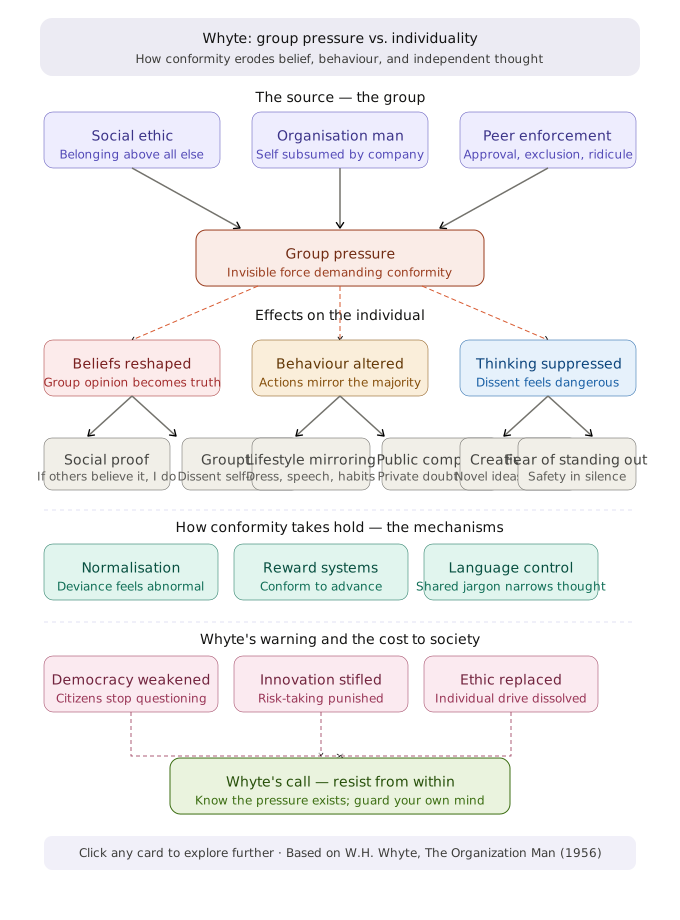
Understanding Group Pressure
Group pressure, a fundamental concept in social psychology, refers to the influence exerted by a group on its members to encourage conformity to certain beliefs, behaviors, or norms. This phenomenon can manifest in various settings such as workplaces, educational institutions, and social gatherings, creating an environment where individual opinions may be overshadowed by the collective mindset. The dynamics of group pressure can be subtle or overt, significantly impacting personal decision-making processes.
Subtle forms of group pressure often involve social norms and expectations that may not be explicitly stated but are nonetheless pervasive. For instance, in a corporate setting, employees may feel compelled to align their work strategies with the dominant culture or popular opinions within their team, leading to a dilution of original ideas. This unwritten rule of conformity can stifle creativity and limit independent thought.
On the other hand, overt forms of group pressure can be more apparent and direct. Peer pressure among adolescents exemplifies this, where individuals may feel the need to engage in specific behaviors, such as substance abuse or risky activities, due to the strong influence of their peers. Such direct confrontations can lead to significant consequences, potentially compromising an individual’s values and personal integrity.
A particularly poignant example of group pressure can be seen in the context of jury deliberations. Jurors may conform to the opinions of dominant jurors, swaying their judgments and undermining their convictions. This illustrates how group dynamics can lead to decisions that reflect the collective opinion rather than individual beliefs.
Overall, understanding the complexities of group pressure is crucial for recognizing its pervasive influence on individual behavior. Awareness of the conditions under which individuals are most susceptible to conformity is essential to fostering an environment that promotes independent thought and healthy debate.
Whyte's Perspective on Individuality
William Fielding Whyte, an influential sociologist, profoundly examined the dynamics of group pressure and its impact on individual identity. His seminal work emphasizes that conformity—the tendency to align behaviors and beliefs with group norms—can significantly undermine personal autonomy and identity. Whyte argues that individuals often sacrifice their unique perspectives to gain acceptance within a social group. This compromise can lead to a loss of self in a societal maze defined by collective standards.
In Whyte's view, the very essence of individuality is threatened when individuals prioritize group consensus over personal beliefs. He posits that while groups can provide support and a sense of belonging, they also produce an environment where dissent is often discouraged. This pressure to conform can suppress independent thought, causing individuals to suppress their ideas and opinions in favor of what is deemed socially acceptable. Consequently, as individuals conform to group expectations, their uniqueness and personal identity may erode, resulting in a homogenized society devoid of diverse perspectives.
Whyte's insights highlight that maintaining one's individuality amidst group expectations is not merely a personal challenge but a societal necessity. He advocates for an awareness of the influences that group dynamics exert on personal beliefs and behavior. By understanding the mechanisms of conformity, individuals can better navigate the balance between fitting in and remaining true to themselves. Embracing individuality enriches communities, fostering innovation and diverse thought that challenge the status quo. In essence, Whyte's perspective serves as a reminder that while human connections are fundamental, the preservation of personal identity is crucial in combating the overwhelming pressures of conformity.
The Psychosocial Mechanisms of Conformity
Understanding the psychosocial mechanisms behind conformity is essential to grasping how group pressure can impact individual thought. Key factors that drive individuals towards conformity include fear of rejection, the innate desire for acceptance, and the effects of social conditioning. These elements often coalesce to create a powerful influence that can suppress independent thought.
Fear of rejection plays a significant role in an individual's decision to conform. Humans are inherently social beings, and the need for belonging motivates them to align their beliefs and behaviors with those of their peers. This fear can lead individuals to abandon personal opinions or values that may not be in line with group consensus, ultimately eroding their ability to think independently. The psychological discomfort associated with social exclusion can drive conformity even in the face of contradictory personal beliefs.
The desire for acceptance further reinforces conformity. Individuals often seek validation from their social circles, prompting them to adopt behaviors and opinions that align with the group's standards. This desire can create an environment where divergent views are stifled, making it increasingly difficult for individuals to express their true thoughts. Ultimately, this dynamic leads to a homogenization of beliefs, where the need for social acceptance overshadows the importance of originality and critical thinking.
Social conditioning is another fundamental mechanism that shapes conformist behavior. From a young age, individuals are exposed to societal norms and expectations that dictate acceptable behavior. This conditioning can instill a mindset that prioritizes conformity over individuality, as people internalize the belief that deviating from the norm may result in social disapproval. Over time, such conditioning can severely limit personal autonomy and independent thought.
In conclusion, the interplay of fear of rejection, the desire for acceptance, and social conditioning forms a complex web that encourages conformity. Understanding these psychosocial mechanisms is crucial for recognizing how they can impact personal beliefs and behaviors, ultimately influencing one's capacity for independent thought.
Real-Life Examples of Conformity's Influence
Conformity significantly impacts individuals across various aspects of life, influencing beliefs, relationships, and decision-making processes. One prominent example can be observed in workplace environments, where employees often feel pressured to align with the prevailing culture and management practices. This desire for acceptance may lead to employees suppressing personal opinions or innovative ideas to match the collective mindset. The phenomenon, often referred to as "groupthink," can stifle creativity and productivity, ultimately affecting organizational growth.
In educational settings, conformity can manifest in peer pressure among students. Many young individuals may conform to the behaviors, attire, or beliefs of their classmates to avoid social ostracism. This pressure to fit in can sometimes lead to detrimental choices, including adopting negative behaviors such as bullying or substance abuse. Alternatively, students who resist such group pressures may experience social isolation, emphasizing the significant cost of independent thought in certain social contexts.
Social circles also play a crucial role in shaping individual behavior through conformity. For instance, in a group where specific political or social views are dominant, members may feel coerced into expressing agreement, even if they hold differing beliefs. This environment may discourage open dialogue and lead to a lack of diversity in perspectives, thereby diminishing the richness of debate and critical thinking.
On a more personal level, the consequences of resisting conformity can be profound. Individuals who choose to assert their independent thoughts and ideas might face backlash, such as alienation or conflict with family and friends. The fear of being labeled as nonconformist can deter many from expressing their true selves in various scenarios. Therefore, it is vital to recognize these influences, as they underline the significant struggle between personal autonomy and social cohesion.
Consequences of Conformity on Independent Thinking
Conformity, often viewed as a social glue that binds individuals within a group, can yield detrimental effects on independent thought and the intrinsic qualities of creativity and innovation. When individuals prioritize group norms and expectations over their personal beliefs and ideas, the potential for unique perspectives diminishes considerably. This suppression of individual creativity arises primarily because conformity encourages a mindset that favors uniformity over diversity in thought.
One of the most significant consequences of such suppression is the stifling of critical thinking. Individuals who conform may hesitate to question prevailing ideas, leading to a homogenization of thought processes. This environment discourages open discourse and critical evaluation of ideas, thereby reducing the potential for intellectual growth. Moreover, when creativity is undermined, innovation suffers as a narrower range of solutions and ideas is considered viable. Thus, the conformity inherent within a group can lead to diminished problem-solving capabilities, as new and unconventional ideas are often overshadowed by more traditional viewpoints.
Over time, prolonged adherence to conformity can foster societal stagnation. Communities or organizations that embrace conformity maintain a status quo that may not be conducive to growth and progress. This creates fertile ground for groupthink, a phenomenon wherein the desire for harmony within a group results in irrational decision-making. As a consequence, critical alternatives are neglected, and potential advancements are left unexplored. Groupthink leads to decisions that not only affect the individual but can also impact larger systems, reducing the overall effectiveness and adaptability of societies in a rapidly changing world.
Strategies to Cultivate Individuality
To maintain one's sense of individuality amidst the pervasive influence of group pressure, it is essential to proactively cultivate independent thought. One highly effective strategy is the development of critical thinking skills. Engaging in activities that challenge preconceived notions can lead to deeper insights and a stronger personal viewpoint. Individuals can practice critical thinking through analyzing arguments, questioning assumptions, and considering multiple perspectives. This approach not only enhances decision-making but also fortifies one's capacity to resist conformity.
Another important strategy is to embrace diversity in opinions. Surrounding oneself with individuals from diverse backgrounds and experiences fosters an environment where varying viewpoints are valued. Engaging in discussions that challenge the status quo can inspire new ideas and reinforce one's own beliefs. By actively seeking out differing perspectives, individuals can become more adaptable and resilient against the pressure to conform, ultimately leading to a stronger sense of self.
Moreover, finding supportive communities that prioritize individuality plays a crucial role in the pursuit of independent thought. Joining groups or networks that celebrate personal expression can provide encouragement and validation. Such environments often encourage members to share their unique ideas and experiences, further enhancing confidence in one's identity. Whether through online forums or local organizations, these communities can serve as essential support systems for individuals striving to maintain their authenticity in the face of societal pressures.
In conclusion, cultivating individuality requires deliberate efforts towards developing critical thinking, embracing diverse opinions, and seeking supportive communities. By implementing these strategies, individuals can strengthen their independent thought and resist the pervasive forces of conformity that threaten their personal identity.
Conclusion: The Balance Between Conformity and Individuality
Throughout our exploration of the dynamics of group pressure and its impact on individuality, it becomes evident that conformity is a powerful social force. While group cohesion can create a sense of belonging and facilitate shared experiences, it often comes at the cost of suppressing independent thought. Understanding this relationship is crucial for individuals who seek to navigate the complexities of social influences without compromising their unique perspectives.
Group pressure can lead to a homogenization of opinions, stifling innovation and creative thought. Individuals may feel compelled to align themselves with dominant norms or popular sentiments, thereby sacrificing their authenticity. However, it is essential to recognize that adhering to group norms does not inherently diminish one’s individuality; rather, it is the manner and degree of compliance that dictates this outcome. By consciously weighing the values of conformity against the importance of personal beliefs and expressions, individuals can maintain their distinctiveness while still participating in collective social dynamics.
Encouraging an environment that values both conformity and individuality is vital for fostering diverse ideas and perspectives. When individuals feel empowered to express their thoughts, even in the presence of group pressure, they contribute to a richer, more vibrant societal tapestry. This balance promotes creativity and innovation, highlighting the role of independent thought in driving progress. Thus, in our increasingly interconnected world, it is imperative to cultivate an understanding of the pressures we face, allowing us to embrace conformity as a tool rather than a shackling force.
Ultimately, recognizing the nuances of conformity can help individuals harness social influences positively, encouraging them to contribute meaningfully to their communities while safeguarding their own unique identities.