
Why Does a Song Get Stuck in Your Head and Won't Leave?
You haven't heard it in weeks. Then someone hums two bars in the break room — and there it is, lodged somewhere between your ears, playing on repeat for the rest of the day. Science has a name for it, and a surprisingly honest explanation.
MENTAL HEALTH & EMOTIONSALL POSTS
Whystill
5/18/20264 min read
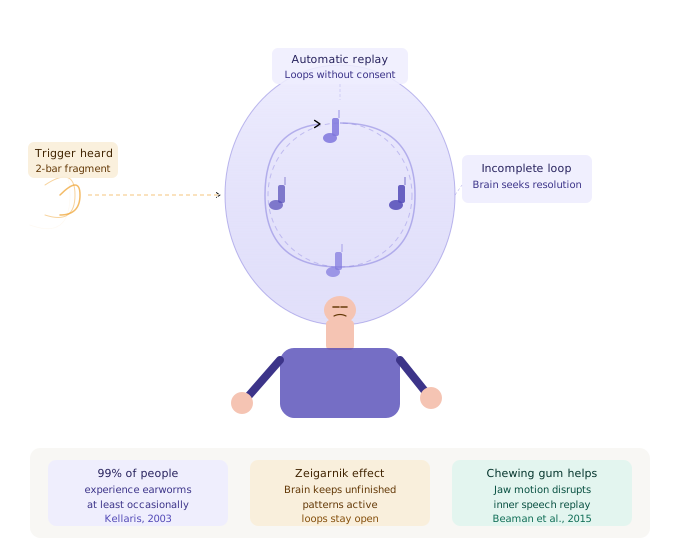
It starts innocuously enough. A colleague's ringtone, the background music in a lift, a cereal jingle from a decade ago and suddenly a fragment of melody is running on a loop inside your skull with no apparent off switch. You try to think about something else. It gets louder. You hum it to a friend to get rid of it. Now they have it too, and they're annoyed at you.
Psychologists call this an earworm from the German Ohrwurm and it is one of the most common involuntary musical experiences humans have. Studies suggest that nearly 99% of people experience earworms regularly, and for roughly a third of us, they happen every single day. You are not losing your mind. You are, in fact, doing something your brain was practically built to do.
The brain loves an unfinished loop
The key to understanding earworms lies in something called the Zeigarnik Effect a psychological phenomenon named after Soviet researcher Bluma Zeigarnik, who noticed in the 1920s that waiters had a remarkable memory for incomplete orders and a near-total forgetting of completed ones. The brain, it turns out, keeps a kind of mental to-do list of unresolved things. Finished tasks get filed. Unfinished ones keep nagging.
Music plays directly into this. Most earworms are not full songs they're fragments. A chorus hook. A bridge. A four-note riff that never quite resolves. Your brain hears just enough to start anticipating the rest, and when the rest doesn't come, it tries to fill in the gap itself. It plays the fragment again. And again. Hoping, in some neurological sense, to close the loop it opened.
"Earworms are the brain's attempt to resolve an incomplete musical pattern — the neurological equivalent of a thought you can't quite finish."
What makes a song earworm-worthy?
Not all music is equally sticky. Research from James Kellaris at the University of Cincinnati who coined the term "cognitive itch" for this phenomenon and later from Elizabeth Hellmuth Margulis at Princeton, has identified several musical features that make songs particularly hard to shake.
What the research found
Songs that become earworms tend to share structural features: a fast tempo, a simple but slightly unexpected melodic contour, and a strong rhythmic pattern. They often contain a short ascending phrase that feels satisfying but incomplete like a question waiting for an answer.
A 2016 study by Jakub Munichor and colleagues found that the interval structure of a melody specifically small leaps upward followed by stepwise descent is a strong predictor of earworm potential. Think of how many famous hooks follow exactly this pattern.
Familiarity matters enormously too. Songs you've heard many times are far more likely to intrude uninvited than songs you only know loosely. Your brain has built a detailed template for familiar music, and even the faintest trigger — a rhythm, a word, a similar chord — is enough to activate it automatically, without any conscious invitation.
It happens more when your mind wanders
Earworms are not random. They tend to arrive when your brain is in a low-engagement state — commuting, showering, doing dishes, lying in bed trying to sleep. These are the moments when your default mode network is most active: the part of your brain that hums along in the background when you're not focused on anything demanding.
In this low-attention state, your mind becomes more vulnerable to involuntary thoughts of all kinds. Earworms are just one variety. Daydreams, sudden memories, half-formed worries — all of these tend to bubble up in the same conditions. The earworm is simply the catchiest of the uninvited guests.
Stress and emotion make it worse
If you've ever noticed that earworms hit hardest when you're anxious or can't sleep, that's not a coincidence. Emotional arousal lowers your brain's capacity to suppress intrusive thoughts, and earworms fall neatly into that category. A stressful day makes the mental jukebox harder to control.
Music associated with strong emotions — a breakup song, a track from a formative summer, anything that carries an emotional charge — is significantly more likely to stick. Your brain doesn't just store the melody; it stores the feeling. And the feeling can pull the melody back to the surface long after the song itself has stopped playing.
How to actually get rid of one
Trying to suppress an earworm directly almost never works — and often makes it worse, a phenomenon researchers call ironic process theory. The more you tell yourself not to think about it, the more cognitive resources you devote to monitoring whether you're thinking about it. Which means you are, constantly.
What does tend to work:
Listen to the full song and let it resolve properly. Closure is often all the brain needs.
Replace it with another song — ideally one that is also catchy but slightly less tenacious. "Happy Birthday" works surprisingly well as a displacement earworm.
Engage your brain in something demanding. A puzzle, a conversation, reading. Earworms need idle mental bandwidth to survive.
Chew gum. A 2015 study found that the chewing motion interferes with the inner speech mechanism the brain uses to replay music internally. Odd, but it has held up in replication.
Accept it. The more neutral you are about the earworm's presence, the faster it tends to fade. Resistance, in this case, genuinely does feed it.
The strange compliment inside the annoyance
There's something almost flattering buried in the phenomenon, if you can get past the irritation. Your brain is capable of holding a piece of music in such vivid detail that it can replay it internally, with full melodic and rhythmic fidelity, entirely from memory. That's a remarkable cognitive feat. No other animal does this. It's a byproduct of the same musical machinery that lets humans create, remember, and share music across generations.
The earworm is the brain's own mixtape — unsolicited, unskippable, but assembled from everything you've ever loved about music. The next time one strikes, consider that your auditory cortex is essentially paying tribute to a song it found genuinely worth remembering. That's either deeply annoying or quietly wonderful, depending on the song.


Categories:
Society & Systems