
Why do we hear our name in random noise — like someone is actually calling you?
You are at a crowded party, deep in conversation, when a word from across the room makes you spin around. No one was talking to you. But your own name, half-swallowed by the noise, sliced straight through everything else. Your brain did this on purpose — and the reason goes all the way down to your sense of self.
DAILY LIFE & TECHNOLOGYALL POSTS
Whystill
5/19/20266 min read
It happens in the most mundane settings. You are in a café, half-listening to the ambient roar of other conversations, and then — there it is. A syllable, or the ghost of one, that sounds unmistakably like your name. You look up. You scan the room. Nobody is looking at you. The person at the next table is talking about something entirely unrelated and your name was never spoken at all.
Or the opposite happens: your name really was spoken, across a room of competing voices, and you heard it perfectly — cleanly — while everything around it blurred into indistinct sound. You turned before you even consciously registered that you'd heard something.
Both experiences spring from the same mechanism, and understanding it reveals something rather intimate about the way the brain processes identity, threat, and the social world at large.
The cocktail party effect
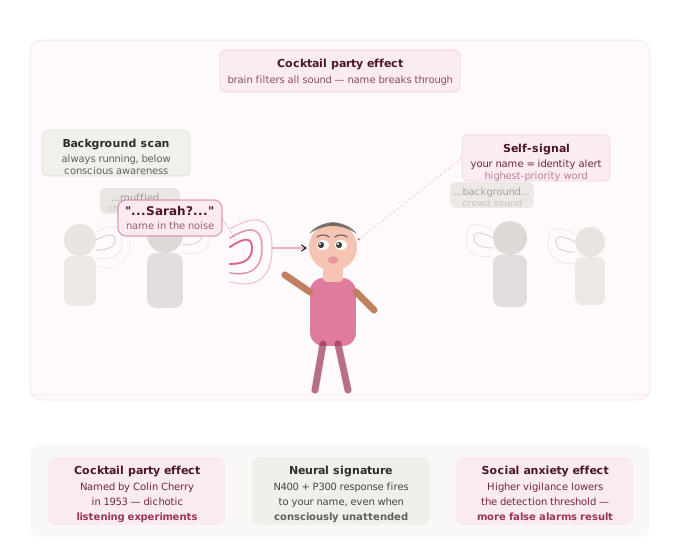
The formal name for hearing your own name cut through background noise is an instance of what psychologist Colin Cherry identified in 1953 as the cocktail party effect — the brain's extraordinary ability to selectively attend to one stream of sound in a noisy environment while suppressing all others. Cherry was fascinated by how people at crowded social gatherings could hold a conversation without being overwhelmed by the noise, and how certain sounds could pull attention away from whatever was being attended to in the moment.
His early work used a technique called dichotic listening: participants wore headphones and received different audio streams in each ear, asked to follow only one. What he found was that people could track the attended stream with high accuracy — but could detect almost nothing from the unattended one. Almost nothing. A handful of things broke through reliably. One of them was your own name.
"Your brain is not passively receiving sound — it is actively filtering it, running a continuous background scan for anything personally significant, even while your conscious attention is pointed somewhere else entirely."
The sentinel in the auditory system
What Cherry's work hinted at, and decades of subsequent neuroscience confirmed, is that the brain maintains two simultaneous modes of listening at all times. The first is focused attention — the stream you consciously follow. The second is a broader, shallow scan of everything else — not detailed enough to comprehend, but sensitive enough to flag anything that might matter personally.
Your own name is one of the highest-priority items on that background watchlist. It has been associated with you since the earliest months of life. Long before you could understand language, you were learning to recognise the specific acoustic pattern of the sounds people used when they wanted you. By the time you are an adult, your name has become one of the most deeply encoded phonological patterns your brain holds — woven into your sense of identity, your expectation of social attention, and your early-warning system for when the world is about to demand something of you.
Neuroimaging studies, including research by Perrin and colleagues published in the journal Neuron, show that hearing your own name activates a broader network of brain regions than hearing other names — including areas associated with self-referential processing in the medial prefrontal cortex, as well as the right hemisphere language areas involved in emotional salience. Your name is not just a word to your brain. It is a self-signal.
Why you hear it even when it wasn't said
The false detections — hearing your name when no one said it — are a direct product of the same system's sensitivity. The auditory cortex is constantly generating predictions about incoming sound based on context, expectation, and prior experience. In a noisy environment, the signal arriving at your ears is degraded and ambiguous. The brain fills in the gaps using probability: given the ambient noise, given the social setting, given your brain's perpetual readiness to hear your name — what is the most likely interpretation of this particular smear of sound?
When the degraded noise happens to share enough acoustic features with your name — a similar number of syllables, a similar rhythm, a matching first consonant — the brain's predictive system resolves the ambiguity in the most personally salient direction. You hear your name. Nobody said it. But the interpretation was not random or irrational. It was your auditory system making a statistically reasonable, if incorrect, inference under conditions of uncertainty.
What the research found
In studies using EEG to measure brain responses, participants showed a distinctive neural signature — the N400 component and later P300 response — when their own name was presented in an unattended auditory channel. This happened even when they were fully engaged with a competing task and could not consciously report hearing their name.
The brain processed the name, assessed its significance, and triggered an attention-shifting response — all below the threshold of conscious awareness. Only after the neural decision to redirect attention did the person become consciously aware that their name may have been spoken.
The role of anxiety and social vigilance
Not everyone hears their name with equal frequency in random noise, and the variance is psychologically meaningful. People with higher levels of social anxiety — those who are more attuned to potential social threat, more concerned with how they are perceived, more alert to signals that they are being discussed or evaluated — show a heightened sensitivity to name-like sounds. Their background watchlist is effectively calibrated to a lower threshold. More sounds get flagged as potentially being their name, and the false alarm rate rises accordingly.
This is not a flaw or a dysfunction. Social vigilance is an adaptive response to environments where being caught off-guard by a social demand carries real costs. The brain of a person who has learned to stay alert in social settings is doing exactly what it was calibrated to do. It is just doing it in a café, scanning for threats that no longer require quite the same level of vigilance.
Equally, people in states of heightened self-focus — thinking about themselves, their reputation, how a conversation went — are more likely to hear their name in ambiguous noise. When the brain is already running self-referential processes, the threshold for interpreting ambiguous sounds as self-relevant drops further still.
What this says about your sense of self
There is something rather profound embedded in all of this. Your name is the oldest and most persistent label your identity has ever worn. It was the first symbol the world used to single you out as a distinct individual — separate from the general noise, worth addressing specifically, a person with a particular location in the social world. The brain's sensitivity to it is, in a sense, a biological monument to the process by which you became a self.
The fact that this sensitivity operates even outside conscious awareness — that your sleeping brain responds to your name, that your unattended auditory stream is perpetually scanning for it, that a degraded fragment of sound across a crowded room is enough to make you turn — suggests that identity is not merely a concept you hold consciously. It is wired into the very architecture of how you perceive the world.
When it becomes something to pay attention to
Hearing your name in random noise very occasionally is entirely ordinary. But if it happens frequently, vividly, and persistently — especially if the voice seems to come from a specific location and direction, or if it carries emotional content — it can cross into what clinicians call an auditory verbal hallucination, or more specifically, a phoneme hallucination. This is qualitatively different from the café experience: a genuine perceptual event, not an ambiguous inference.
If you notice this pattern, it is worth mentioning to a doctor — not because it necessarily signals anything serious, but because it can occasionally be a symptom of conditions from sleep deprivation and extreme stress to more significant mental health presentations that respond well to early attention. The occasional false alarm in a noisy room, on the other hand, is simply your brain being a very conscientious guardian of your name.
Your brain maintains a background scan of all ambient sound, even when you are consciously attending to something else entirely.
Your name has the highest priority on this watchlist — more than any other word in the language — because of its deep association with self and social demand.
False detections are reasonable inferences, not errors — the brain resolving acoustic ambiguity in the most personally significant direction available.
Social anxiety raises the threshold sensitivity, making name-like sounds more likely to break through from the unattended stream.
Vivid, directional, or persistent experiences of hearing your name are worth discussing with a professional — they represent a different phenomenon from the ordinary cocktail party variety.
The next time a noise makes you spin around at a party, only to find no one looking at you, do not feel embarrassed. Your brain just did something genuinely impressive: it filtered an ocean of sound, found a pattern that matched the most important word in your personal lexicon, and redirected your attention in a fraction of a second. It was wrong. But it was very, very fast.
You might also like


Categories:
Society & Systems