You were just in the living room, absolutely certain of what you needed. You stood up, walked twelve feet, crossed the threshold into the hallway and the thought evaporated. You stand there, blinking at the refrigerator, hoping it will remind you. It doesn't.
This is one of the most universally relatable moments in human experience, and for decades it puzzled psychologists. Was it distraction? Age? A sign of something wrong? As it turns out, none of the above. The answer is architectural and it lives in how your brain draws mental borders around experience.
The doorway is not just a door
In 2011, researchers at the University of Notre Dame ran a series of experiments that changed how scientists understand everyday forgetfulness. Led by Gabriel Radvansky, the team found that people were significantly more likely to forget information after walking through a doorway than after walking the same distance within a single room.
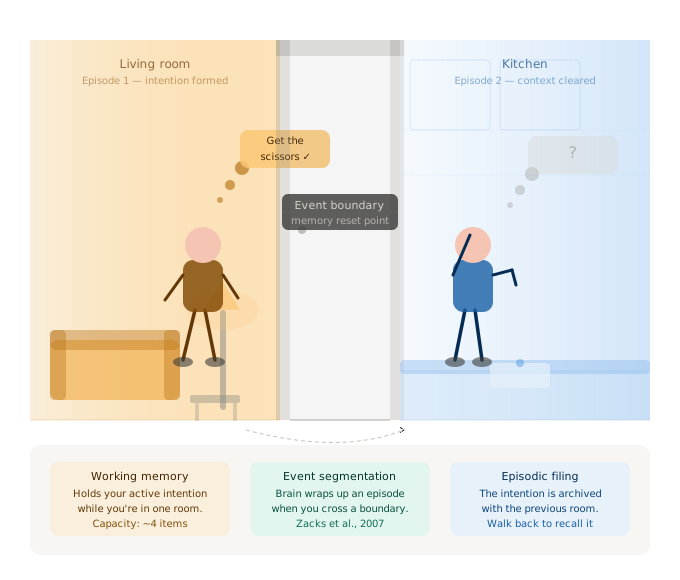
The doorway itself wasn't incidental it was the mechanism. The brain uses physical boundaries as mental punctuation. When you pass from one room to another, your brain interprets that transition as the end of one episode and the beginning of a new one. The intention you formed in the living room gets filed away as part of that episode, neatly sealed off from the new context you've just entered.
"Walking through a doorway triggers what psychologists call an 'event boundary' — a mental bookmark that separates experiences into discrete chapters."
Event segmentation theory
The scientific name for this phenomenon is rooted in Event Segmentation Theory, developed by Jeffrey Zacks at Washington University. The idea is that our brains are constantly parsing the continuous stream of experience into distinct, manageable episodes the way a film editor cuts footage into scenes.
When you're sitting in one room forming a plan, that plan gets encoded as part of that room's episode. The moment a boundary is crossed a doorway, a staircase, stepping outside the brain wraps up the previous episode and boots up a new context. The old episode, including your intention, is no longer in active working memory. It's been archived.
What the research found
Radvansky's team tested participants both physically (walking through rooms) and virtually (navigating on a computer screen). The forgetfulness effect appeared in both conditions, confirming it's a cognitive phenomenon not just about physical movement.
Participants who passed through doorways forgot significantly more than those who walked equivalent distances in open space even when given extra time to recall.
Why does the brain do this at all?
It might seem like a design flaw, but event segmentation is actually one of the brain's great efficiencies. Constantly holding every thought, intention, and memory in active working memory would be overwhelming. The brain needs to decide what's currently relevant and what can be set aside.
In most of our evolutionary history, changing physical environments genuinely meant a change in context — moving from a shelter into the open, crossing from one terrain to another. The brain learned to treat spatial transitions as meaningful cues, clearing out old context to make room for the new environment's demands. The kitchen isn't the living room. You need fresh attention, not stale plans.
The problem, in modern life, is that crossing a doorway usually doesn't mean a complete shift in goals. You still need that phone charger. But your brain didn't get the memo.
It has nothing to do with age
Many people assume this kind of forgetfulness is a sign of cognitive decline, particularly as they get older. This is largely a myth. The doorway effect occurs across all age groups, including children and young adults. While older adults can experience more pronounced memory challenges generally, the doorway effect specifically is a universal feature of human cognition not a warning sign.
If it's been happening to you your entire life but you only started noticing it recently, the more likely explanation is that you're paying more attention to your lapses than you used to not that something has changed in your brain.
How to work with it, not against it
Since the effect is structural, you can't simply try harder. But you can use simple strategies that take advantage of how memory actually works:
Say it out loud. Verbalising your intention ("I'm going to get the scissors") encodes it more deeply and keeps it accessible across the boundary.
Visualise the object clearly before you move. A vivid mental image creates a stronger memory trace than a vague impulse.
Return to the original room. Retracing your steps physically re-opens the episode your memory was stored in. This is why it works so reliably — you're not just hoping; you're triggering the right context.
Reduce competing intentions. If you're thinking about three things at once, only the strongest will survive the crossing. Finish one task mentally before starting another.
Write it down before you move. The act of writing locks an intention into external memory — immune to event boundaries.
The strange comfort of it
There's something quietly reassuring about all of this. The next time you stand in the hallway, grasping at a vanished thought, you can remind yourself that your brain is doing exactly what it was designed to do — filing away the past and opening a fresh page for the present. The irony is that this is a feature of a well-functioning, highly adaptive mind.
The thought isn't gone, exactly. It's just been shelved. Walk back. It'll be waiting.


Categories:
Society & Systems