
Why do we always wake up just before the alarm?
You set it for 6:47. You open your eyes at 6:44. The alarm hasn't gone off. It never needed to. Somewhere deep in your biology, something knew — and that something has a name.
MENTAL HEALTH & EMOTIONSALL POSTS
Whystill
5/19/20265 min read
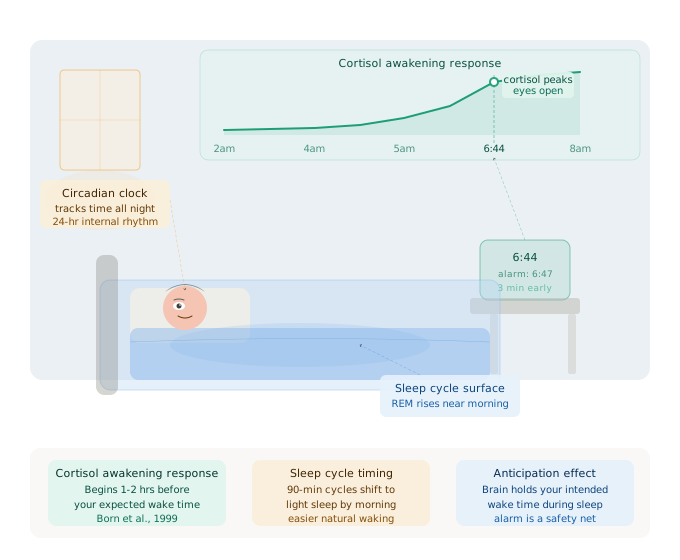
There are few things quite as quietly impressive as opening your eyes in the morning, reaching for your phone, and finding that the alarm is still three minutes away. You didn't need it. Your body, without any instruction from your conscious mind, simply woke you up at the right time. No buzzing. No mechanical jolt. Just a gentle, internal nudge from your own biology.
It feels like a trick. It feels, honestly, a little magical. But the science behind it is both elegant and surprisingly well understood and it says something rather interesting about how much your brain does while you think you're simply sleeping.
Your body has its own clock
The foundation of this phenomenon is something called the circadian rhythm your body's internal 24-hour clock, regulated by a tiny cluster of neurons in the brain's hypothalamus called the suprachiasmatic nucleus, or SCN. This clock doesn't just track time passively. It actively drives hormonal cycles, body temperature, digestion, alertness, and crucially the timing of sleep and waking.
About one to two hours before your expected waking time, regardless of whether you set an alarm, your body begins a quiet biological preparation for consciousness. Cortisol often framed as a stress hormone, which does it something of a disservice begins to rise. This pre-dawn cortisol surge, known as the cortisol awakening response, is essentially your body's natural alarm system. It raises blood pressure gently, raises alertness, and mobilises energy stores. By the time you actually open your eyes, your body has been warming up for a while.
"Your brain doesn't switch off when you sleep — it monitors time, anticipates the morning, and begins preparing your body for wakefulness long before you're conscious of any of it."
The role of stress and anticipation
Here is where it gets psychologically interesting. Research published in the journal Psychosomatic Medicine by Jan Born and colleagues found that people who expected to wake up at a specific time particularly those who were anxious about it showed a significantly stronger cortisol surge in the hour before that exact time. Not before sunrise. Not at a random hour. Before the specific time they had told themselves they needed to wake up.
The brain, while you slept, held onto that information. It processed it as a kind of anticipatory task, flagged it as important, and began mounting a physiological response in preparation. The alarm didn't trigger waking the expectation of the alarm did. The alarm was, in a quiet sense, redundant.
In Born et al.'s study, participants who were told they would be woken at 6am showed a sharp cortisol rise starting around 5am. Participants told they would be woken at 9am showed the same rise but shifted, beginning around 8am. The cortisol response was following their expectation, not the clock on the wall.
A follow-up study found this effect was weaker in people who had no particular anxiety about missing their wake time, suggesting the arousal mechanism is partly driven by the emotional weight we attach to the morning's demands not just by the time itself.
Sleep cycles and the lucky timing
There is a second, more mechanical explanation that works alongside the hormonal one. Sleep is not a flat, uniform state. It cycles through distinct stages light sleep, deep sleep, and REM sleep roughly every 90 minutes across the night. Waking during light sleep feels gentle and natural; being woken from deep sleep feels disorienting and grim, which is why the alarm sometimes feels like being dragged through gravel.
As morning approaches, sleep architecture shifts. The proportion of REM and light sleep increases; deep sleep recedes. Your body is naturally spending more time closer to the surface of consciousness. If your alarm is set for a time that coincides with one of these lighter phases, waking a few minutes before it isn't magical timing it's just your body completing a cycle and surfacing on its own. The alarm set the outer boundary; your sleep cycle did the rest.
Why it doesn't always work
If this internal clock is so reliable, why do we still sometimes sleep straight through the alarm? A few things can disrupt the system. Accumulated sleep deprivation overrides the anticipatory cortisol response — when the body is severely under-slept, the pressure to stay asleep is simply too strong for the gentle biological nudge to break through. Alcohol suppresses REM sleep and flattens the normal architecture of the night, making the body less able to self-time the approach to waking.
Shift work and irregular schedules confuse the circadian clock. When you go to bed at wildly different times each night, your body doesn't know what to prepare for. The anticipatory mechanism works best when you keep a consistent schedule — not because of discipline or willpower, but because the biological clock genuinely needs the repetition to set itself accurately.
What this reveals about the sleeping brain
The broader implication of all this is quietly astonishing. Your brain, while you sleep, is not offline. It is monitoring time. It is holding your intentions. It is managing your hormonal chemistry. It is tracking the external cues — light, temperature, sound — that help it triangulate where you are in the night. Sleep looks like absence from the outside. From the inside, it is a carefully managed biological event, continuously updated, and aimed — at least in part — at delivering you back into consciousness at the moment you need to be there.
The alarm clock was a response to a very real human anxiety: the fear of oversleeping something important. But for most people, most of the time, their body was already on it. The alarm is really just a safety net. And safety nets, by definition, are most reassuring precisely when they're never needed.
How to work with your internal clock, not against it
Keep a consistent wake time, even on weekends. Your circadian clock strengthens through repetition — irregular schedules dilute its accuracy.
Set the intention before you sleep. Research suggests that consciously registering the time you need to wake — rather than just relying on the alarm — genuinely improves your body's anticipatory response.
Let morning light in early. Light is the primary signal that resets and confirms your circadian clock. Opening the curtains soon after waking anchors your rhythm for the next night's timing.
Avoid alcohol close to bedtime. It disrupts the sleep architecture that makes natural pre-alarm waking possible.
Count sleep cycles rather than hours. Waking at the end of a 90-minute cycle — 6 hours, 7.5 hours — tends to feel far more natural than waking mid-cycle at precisely 8 hours.
The next time you beat your alarm, try resisting the urge to feel smug about it — though a little smugness is probably fine. What you're actually experiencing is a finely tuned biological system doing exactly what it evolved to do: reading the night, counting the hours, and gently returning you to the world right when you asked it to.


Categories:
Society & Systems