
Why do our best ideas arrive in the show
The water is running. You're thinking about nothing in particular. Then — with no effort at all — the solution to a problem you've been wrestling with for three days simply arrives. You reach for a towel. By the time you find one, it's already starting to fade.
WORK & AMBITIONALL POSTS
Whystill
5/19/20266 min read
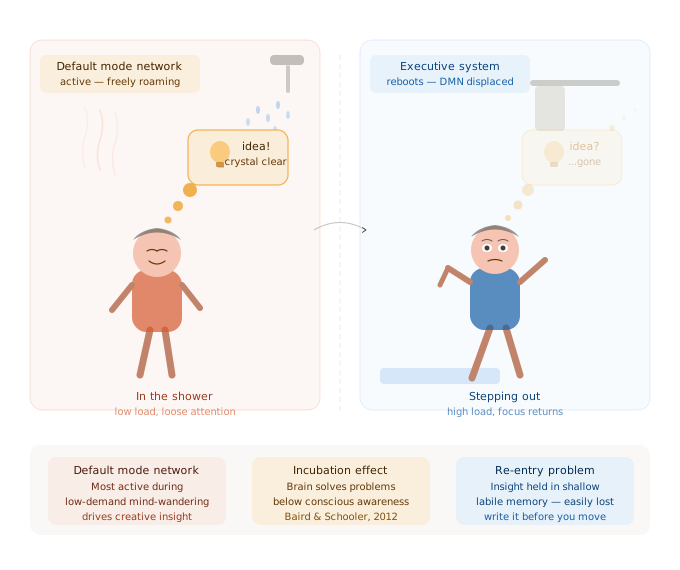
It has happened to almost everyone. You've been stuck on something a work problem, a creative block, a sentence that won't come and no amount of sitting at a desk and concentrating has helped. Then you step into the shower, your mind loosens, and the answer appears as if it had been waiting patiently just behind a curtain, ready to walk onstage the moment you stopped looking directly at it.
The tragedy, of course, is the second act. You step out, reach for your phone or a notepad, and the idea so vivid and complete just thirty seconds ago is already dissolving at the edges. By the time you're dry, it's gone entirely. You are left holding a towel and a dim memory of having once known something important.
Both halves of this experience are real, and both have explanations. The shower is not magic. But what it does to your brain is genuinely remarkable.
The default mode network and why doing nothing is doing something
When neuroscientists began mapping brain activity in resting subjects people lying still, not concentrating on any particular task they expected to find the brain quietly powering down. What they found instead was startling. A specific network of regions lit up with intense activity precisely when the brain appeared to be doing nothing. They named it the default mode network, or DMN.
The DMN is active during mind-wandering, daydreaming, and loosely unfocused thought. It is the network that hums along when you stare out of a window, take a walk, or stand under warm running water with no particular agenda. And far from being a resting state, it appears to be one of the brain's most productive: associated with autobiographical memory, future thinking, social cognition, and crucially the kind of remote associative thinking that underpins creative insight.
"When you stop trying to solve a problem, your brain doesn't stop working on it. It hands the problem to a different department — one that operates below conscious awareness and has access to a far wider archive."
Incubation and the unconscious search
The psychological term for what happens in the shower is incubation — the phase of creative problem-solving that occurs after you've loaded a problem into your mind and then deliberately stepped away from it. During incubation, the brain continues processing the problem below the threshold of conscious awareness. It draws on distant associations, cross-domain analogies, and loosely connected memories that the focused, deliberate mind tends to overlook or suppress.
Focused attention is, paradoxically, limiting. When you sit at a desk and think hard, you activate the prefrontal cortex's executive control system, which is excellent at logical, sequential reasoning but tends to fixate on familiar paths. The shower interrupts this fixation. The moment you relax the grip of focused attention, the brain's broader associative network — the DMN — is free to roam and make connections that the focused mind would never have reached.
A 2012 study by Benjamin Baird and Jonathan Schooler at UC Santa Barbara found that participants who performed an undemanding task — one that allowed mind-wandering — showed significantly better performance on subsequent creative thinking tasks than those who rested quietly or who engaged in a demanding task.
The key wasn't rest itself. It was the specific quality of mind-wandering: a loosely engaged, inwardly directed state that let the DMN activate fully. Too much focus blocked insight. Too much rest missed the associative spark. The sweet spot was the gentle, undirected attention of a shower, a walk, or washing up.
The shower's specific advantages
Not every idle moment produces the same quality of thought. The shower has a handful of qualities that make it a particularly fertile environment for insight. Warm water triggers a mild release of dopamine, the neurotransmitter associated with reward, motivation, and — importantly — the broadening of attentional focus. A slight dopamine uplift makes the mind more expansive and more willing to entertain remote associations rather than staying locked on the nearest, most obvious path.
The shower is also a low-stimulation environment. There's nothing to look at, no notifications, no decisions to make. Your cognitive load drops to nearly zero. This is significant because creative insight tends to surface when the brain is freed from the demands of managing incoming information. The shower essentially creates a protected mental space — enclosed, warm, slightly monotonous — that the DMN is ideally suited to fill.
Finally, there is the ritual familiarity of it. The shower is so deeply automatic that it demands almost no conscious attention. Your hands know exactly what to do. This procedural autopilot frees your working memory entirely — and working memory, when not occupied with a task, appears to become available for the kind of loose, wide-ranging thought that produces creative connections.
Why the idea dissolves the moment you step out
The moment you step out of the shower, the environment changes completely. You are suddenly making decisions: reach for the towel, find your phone, don't slip, remember to turn off the water. Your executive system reactivates immediately. The prefrontal cortex comes back online and begins managing the present moment's demands — and in doing so, it competes directly for the same neural resources that were, just seconds ago, holding your fragile new idea.
The insight itself was never strongly encoded to begin with. It arrived as a loose, associative signal — a feeling of connection more than a fully formed thought. These kinds of insights are held in a shallow, labile form of memory: vivid in the moment, but not yet consolidated into anything stable. The cognitive noise of re-entering normal life is more than enough to displace them before they have a chance to be properly stored.
This is why simply wanting to remember the idea is rarely sufficient. The intention to remember is itself a form of cognitive effort — and effort, in this context, is exactly what breaks the fragile state that produced the idea in the first place. You can't hold the shower and the towel in your hands simultaneously.
How to actually keep the ideas
The good news is that the answer here is mechanical, not psychological. You don't need to change how your brain works — you need to change what happens in the fifteen seconds after the idea arrives.
Keep a waterproof notepad in the shower. They exist, they are inexpensive, and they work. Writing the idea down while still in the water bypasses the re-entry problem entirely. You don't need to capture the full thought — a few words is enough to anchor it.
Speak it aloud. Vocalising an idea encodes it differently and more robustly than just holding it in mind. Many people find that saying the idea out loud — even to no one — makes it far more likely to survive the transition out of the shower.
Don't rush. The impulse to dash out and write it down is understandable, but the act of rushing re-activates executive attention far too quickly. Stay in the shower for another thirty seconds and let the idea develop slightly before you move.
Associate it with something concrete. Link the idea immediately to a vivid, specific image or anchor — a person's face, a physical object, an absurd metaphor. Bizarre associations are surprisingly durable. Bland ones are not.
Place a voice recorder or phone within arm's reach, just outside the shower. Pressing one button and speaking for ten seconds is achievable without fully re-engaging the executive system.
The deeper lesson in all of this
There is a broader implication here that is easy to miss in the frustration of losing a good idea. The shower works precisely because you stopped trying. The best thinking your brain is capable of does not always happen when you are sitting at a desk, applying effort, and staring at the problem. Sometimes — often, actually — it happens when you look away.
The insight that arrives in the shower is not a lucky accident. It is the product of a genuinely different cognitive mode: one that requires idleness, low stimulation, and the absence of pressure to perform. A culture that treats busyness as virtue and rest as laziness is, in this light, systematically starving the part of the mind most responsible for its best ideas.
The shower is a two-minute argument for doing less. It is also, for most people, the most intellectually productive room in the house. That says something worth sitting with — preferably under warm running water, with nowhere particular to be.
You might also like


Categories:
Society & Systems