
Why do 50,000+ people all stop breathing at exactly the same second — for a ball that hasn't landed yet?
The most unsolved human frustration in sport, and it happens every single match.
ALL POSTSSOCIETY & SYSTEMS
Whystill
6/14/20263 min read
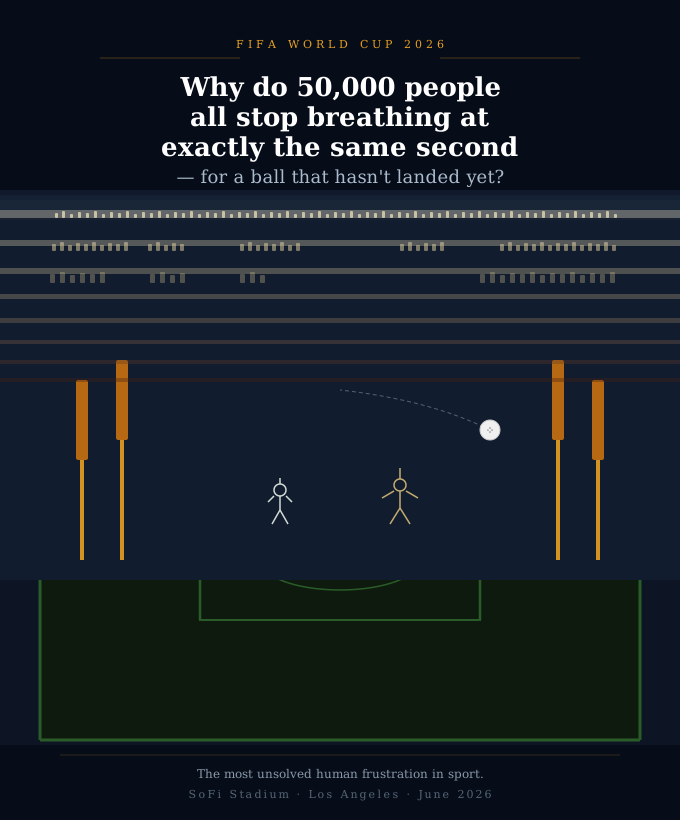
It was the 67th minute. USA vs Paraguay. SoFi Stadium, Los Angeles. FIFA World Cup 2026.
Christian Pulisic received the ball thirty yards from goal. He turned. He drove forward. The crowd of 75,000 people — who had been breathing, shifting, talking, sipping drinks one second earlier — went completely, collectively, biologically still.
Not quiet. Still.
75,000 pairs of lungs stopped. 75,000 hearts accelerated. 75,000 bodies rose from their seats without deciding to. The shot came. It struck the outside of the post. The roar that was loaded, cocked, and ready — never arrived.
What followed was not silence. It was something worse. It was the sound of 75,000 people trying to exhale something that had nowhere to go.
This is not disappointment. It is something older.
Psychologists call it “frustrative non-reward” — the specific pain that comes not from never having something, but from having it taken away at the last possible moment. The brain, which had already begun celebrating, must now reverse an emotion mid-flight. It is neurologically more painful than simply not scoring at all.
But that clinical definition misses the texture of it. Because what happens in a stadium in that suspended second is not merely personal. It is collective. Synchronized. 75,000 nervous systems hijacked simultaneously by the same hope, crashing into the same wall, at the same instant.
There is no other moment in human experience quite like it.
The body prepares for a release it never gets.
When a striker runs at goal, your body does not wait for the outcome. It prepares for it. Adrenaline releases. Muscles tense. You stand — not as a decision, but as a reflex. You inhale. You grab the person beside you. Your brain, running slightly ahead of reality, begins the celebration.
Then the ball goes wide.
All that energy — real, physical, biochemical energy — has nowhere to go. The groan is not enough. The slumping back into the seat is not enough. The head in the hands is not enough. Your body generated the resources for a celebration and must now quietly, humiliatingly, absorb them back.
It is like a sneeze that builds completely, takes over your entire face, and then simply… doesn’t come. Multiplied by a thousand. Felt in your chest.
You were certain, for exactly one second.
This is the cruelest part. Not the miss itself. The certainty that preceded it.
In that half-second when Pulisic’s foot connected with the ball, the American fans at SoFi Stadium did not think it might be a goal. They knew it was. The nervous system had already filed it. The joy had already started. And then reality rewrote the moment, and the brain had to un-know something it had just known.
That reversal — of a joy already felt — is not frustration in the ordinary sense. It is grief. You are mourning something you briefly, genuinely possessed.
And yet — you will do it again next match.
This is the paradox that no one in sport talks about. Fans know this might happen. They have felt it before. They understand, rationally, that hope creates vulnerability. And they show up anyway — fully open, fully undefended, ready to have their breath stolen again.
The 2026 World Cup, the largest in football history with 48 nations competing across the United States, Canada, and Mexico, has produced this moment thousands of times already in its opening days. In Dallas. In Seattle. In Mexico City. In Toronto. In stadiums packed with people from every corner of the world, all of them performing the same involuntary act — stopping breathing together, for a ball that hasn’t landed yet.
FIFA can sell you the ticket. They can give you the seat. They can build you the stadium.
But that one second — suspended, electric, excruciating — is the only thing at a World Cup that nobody planned, nobody sold, and nobody can take away.